Rain thick as blood coating what’s left of the window.
River of broken glass stealing what’s left of the moon.
Poem by Allison Goldstein (2024)
This is one of the poems that came from writing my horror collection, but didn’t make it into the final book. I wrote three of these poems (that I still really like), including “If You Want to Live” as writing exercises to get into the themes and tropes of horror films.
For a while I called these extra poems ‘appendixes’ and even tried them as chapter intros; but alas, they just needed to find a new home. Since the poems explore larger themes in horror vs. commenting on individual films, they didn’t seem to quite fit in with the chapbook, but I love them anyway for the spooky little poems they are. Perhaps they’ll be part of a larger, different collection eventually.
From the book “In The Night, In The Dark” by Bottlecap Press (2025).
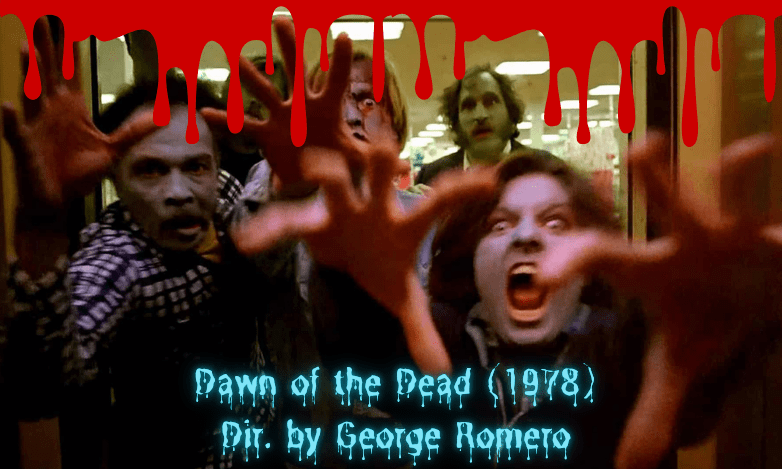
I love this weird little poem. It’s actually one of the first poems I wrote for the collection and probably the shortest poem I’ve ever published. “Dawn of the Dead” originally appeared in Molecule – a tiny lit mag in Fall 2022 and I love that it found a home that appreciated both its humor and brevity.
One of the things I adore about horror as a genre is it’s ability to interject comedy and camp with serious messages about fear, society, and human nature. Romero’s 1978 classic “Dawn of the Dead” is a masterclass in this area, dazzling audiences with the perfect combination of gory practical effects (due to the genius of Tom Savini), campy yet creepy zombies, and a still-relevant message about the dangers of over-consumerism, and its physical, emotional, and psychological effects on society.
Romero has always been a pro at understanding how to create a solid plot that makes sense on its own but leaves a lot of space for wider thematic interpretations. Is it a coincidence all the zombies descend on the mall? Absolutely not. Mall culture in the U.S. was already booming in the late 70s (and would only grow exponentially through the 80s and 90s). This era ushered in a major cultural shift, eschewing the importance of community for rampant greed and consumerism. Society encouraged people to make as much money as possible and spend it all on themselves to help drive corporate profits. As a result, American social culture became inexplicitly intertwined with shopping and consumerism.
It’s also not a coincidence that themes of unrestrained consumerism easily mirror the concept of mindless zombie hoards solely driven by a innate desire to consume. They come to the mall out of habit, but also as a symbol of what unfettered consumerism will ultimately cost – humanity itself. It’s terribly smart and awfully funny and one of the best zombie films of all time. I only hope my small poem does it a hint of justice.
I’ve waited for this day for years and I can’t believe it’s finally here. My first poetry chapbook, In The Night, In The Dark, is live and available from Bottlecap Press!
A haunting ode to Universal Monsters, 80s slashers, and Final Girls, In The Night, In The Dark is a razor-sharp collection of ekphrastic poems inspired by classic 20th century horror films. From The Bride of Frankenstein’s first hiss to Pamela Voorhees searching for her son’s lost heart, each poem explores the cinematic chasm between dread and desire.
Dark, witty and unsettling, the poems reimagine horror films not as passive nightmares, but emotional reckonings, including “Dracula,” “Creature from the Black Lagoon,” “Night of the Living Dead”, and “Suspiria”. Allison Goldstein’s deftly crafted collection meditates on the transformational impact of our collective terror – both on and off the screen.
Are you ready to step back into the dark and confront what haunts you?
Don’t take your clothes off
or investigate the strange noise
at the end of the hall.
Don’t count on the phone working
(any phone)
or the car in the driveway.
Never go to sleep,
even if you make it to sunrise.
Never feel safe,
even with a knife in his chest.
He’s not dead,
just waiting.
Poem by Allison Goldstein
I love horror movies. Is that obvious? I also love writing poems about horror movies, including “If You Want to Live”, which offers some pertinent advice to anyone who happens to find themselves trapped in a horror film. This is definitely a condensed list, so what would you tell someone to help them try to survive a horror movie?
I am poet and not a math person. That’s not to say it’s an inherent flaw with all poets. Most people in general are better at numbers than I am, which I guess is one of the reasons I find them so intriguing. As a concept, complex math exists so far outside my realm of understanding that I can only gaze upon it in awe and remain thankful there are people who can conceive of such wonders.
Poets often have to consider numbers one way or another when addressing form. There’s the 14-line sonnet, the 10 syllables in a line of iambic pentameter, or actual Equation Poetry that invites mathematical symbols and formulas into conversation with a poet’s words. The musicality of phrasing, rhyming structures, meter – math is an essential component of formal poetry. And like all restrictions, creates both structural limits and creative opportunity.
One of the most exciting forms of mathematic poetry are Fibonacci poems. These poems take their structure directly from the Fibonacci Sequence – a numerical series where each new number is the sum of the two numbers that precede it, for example:
0, 1, 1, 2, 3, 5, 8, 13, 21, 34, 55, 89…
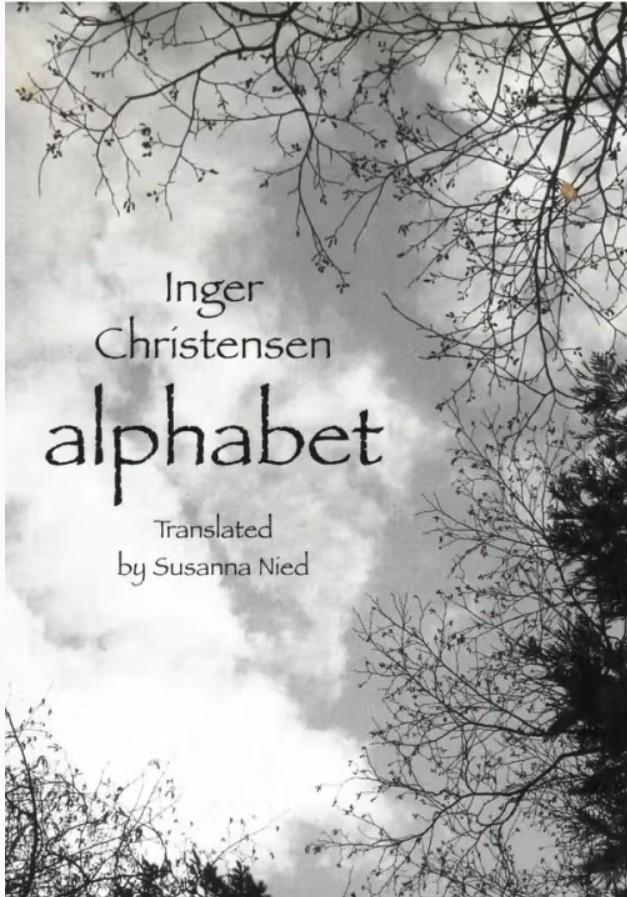
My all-time favorite Fibonacci poem is the famous book “alphabet” by Inger Christensen (translated from Danish by Susanna Nied). It’s a beautifully conceived book-length poem that is both Abecedarian (each line begins with the next letter of the alphabet in sequential order – A, B, C, D, etc.), AND written in 14 sections with each section’s line length dictated by the corresponding number from the Fibonacci sequence. For example: Section 1 of the poem, “A”, has only one line, while the last section of the poem, “N”, has a total of 610 lines.
‘alphabet’ by Inger Christensen, Translated by Susanna Nied (New Directions, 2000)
The poem builds organically, starting with the simple image of an apricot tree – “apricot trees exist, apricot trees exist.” The first few sections of the poem embrace this cadence of repetition and alliteration, naming even more everyday things that exist from blackberries and citrus trees to hydrogen. As each section doubles in line length from the one before it, the poem takes on a natural tension, growing grander in scope both physically and thematically. Suddenly along with ‘early fall’ and ‘elk’, we start to see more abstract ideas like ‘afterthought’ and ‘memory’s light’. These ethereal observations take a more sinister turn by section 7 where “guns and wailing women, full as greedy owls exist…”.
The poem continues to build a world that erupts out of itself, weaving the reader through a complex and mesmerizing tapestry of natural elements and the complexities of the human experience – love, fear, war, death, destruction. And we as the readers are not removed from the equation. We are part of the things that exist and act as a witness to what exists – the beauty and the horror alike.
It’s a wildly successful example of a mathematical form not only supporting the poem visually and musically but reinforcing the very structure of the narrative. The stakes get higher as the lines get longer. The ideas go from granular to metaphysical, starting from that simple image of the apricot tree. It’s complex without being inaccessible and a joy to revisit – even as the darker themes spread their fingers throughout the verse.
My Take on a Fibonacci Poem
When I first read alphabet in the early 2000s, I was inspired to write my own silly version of a Fibonacci Poem by focusing on another anachronistic device – the answering machine. A very long time ago I had an apartment in Oakland with my boyfriend (now husband) Kaleb and our friend Aaron. It had a landline and an answering machine.
Shortly after moving in, we started getting messages for a guy named Jeff, and those messages told the story of a messy breakup between Jeff and Linda. These people were looking for answers they were never going to get – at least not from us. They also never seemed to call while anyone was home. The three of us didn’t know how else to handle the situation, so we changed our answering machine’s outgoing message to break the bad news to all the Jeff and Linda fans. That message inspired the following poem:
The Problem of Answering Machines (a Fibonacci poem and imperfect response)
… no, we are not here right now to accept your call, but appreciate your attempt at communication, well aware that this may not be enough time to record your intentions, but by reducing our connection to your name, number, and brief outlining of your purpose for contact, citing specific examples of why this conversation may at all prove pertinent to our overall wellbeing will be useful in deciding whether or not to return said call in any timely fashion as it relates to what time if any we have in the future to commit—
<beep>
Jeff and Linda do not live at this machine, they have told us to say that they will not be returning your call; they have no new number
and no, he does not love her anymore.
– Allison Goldstein, 2005
The first section of the poem mimics an overly long outgoing answering machine message and follows the Fibonacci Sequence with 0, 1, 1, 2, 3, 5, 8, 13, 21, 34, 55 syllables-per-line.
The poem then resets at the <beep>. The ‘response’ section after the beep also follows the Fibonacci Sequence until the very last line, which doesn’t fulfill the syllable quota and is therefore imperfect (as the title states) to mirror that message that the couple has broken up/disconnected.
Let this be a lesson that it’s fun to play with form – even if you come up with a perfectly imperfect math poem about a technology that hasn’t properly existed in 20 years. Happy writing!
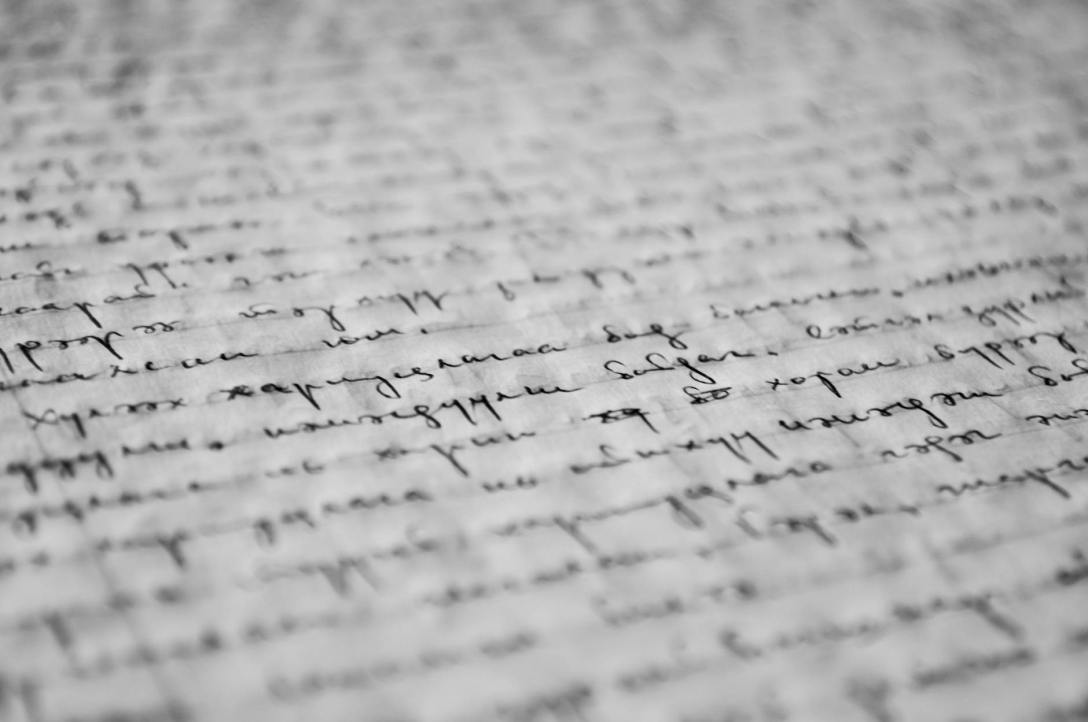
This poem was originally published in Cicatrix: A Journal of Experimentation in 2017. I wanted to play with the concepts common in erasure poems, exploring both form and formatting by creating space between the words that can be a placeholder for a breath as well as to leave room for both anticipation and surprise. The idea of ink disappearing also plays with the idea of memory – one of the most frequent themes in my work. I loved the idea of ink fading over time the same way memories fade over time, adding another layer of complexity when trying to relive a moment, a story, or a feeling.
This poem originally appeared in Switchback Journal (from the University of San Francisco) back in 2006. It’s part of a small series of poems I started forever ago about expressive gestures. Additional poems from this mini collection include Wink, Smile, and Leer. When I started the series, I was reading ‘The Seventy Prepositions’ by Carol Snow and enamored with the idea of taking a small gesture and diving into it from physical, emotional, and etymological perspective.


 Allison Goldstein