

Margaret White is a horror icon in life and in death. While several extremely talented actresses have taken on the role of Carrie White’s fanatical mother, no performance has reached the charismatic yet unhinged fever dream of Piper Laurie in Brian De Palma’s 1976 adaptation of Carrie. Laurie’s ability to capture the both the zealotry and otherworldly oddness of Margaret White remains a beacon for horror fans and an enduring pop culture reference nearly 50 years after the movie’s original release.
Pre-production, Piper Laurie famously believed Carrie was a ‘lyrical black comedy’ and not an actual horror film. She couldn’t comprehend that this deranged woman who shouted about her daughter’s “dirty pillows” could be anything but satire. Even if initially misguided, I think this perspective ended up freeing Laurie to explore the frenetic darkness of Margaret White without a need to ground the character in realism—consequently creating a silver screen portrayal that defied genre.
Laurie earned her a second Oscar nomination for transforming Margaret White into a fully-conceived villain that is gleefully over-the-top yet entirely believable. With an untamable mane of hair, dramatic cape, and a sing-songy voice that vacillates between vulnerable and manipulative, her very presence vibrates off the screen with a confidence that seems even more gauche next to Carrie’s overwhelming shyness.
From the moment we see her proselytizing to the neighbors, we know exactly who Margaret White is, and how her religious fervor shapes the way she both perceives and abuses her daughter. Her dogmatism acting as both a mask and a projection of her inner turmoil.
It’s easy write off that kind of character as just another blind Christian fanatic, but Piper Laurie as Margaret White radiates such an intensely felt sense of self that it permeates her religious zealotry. There is an argument to be made that Margaret White is the actual God she claims to worship under another name. Her staunch refusal to engage with reality combined with an unyielding need for control makes Margaret feel more like the leader of her own one-woman cult vs. a humble servant of her professed faith.
**Spoiler Alert**
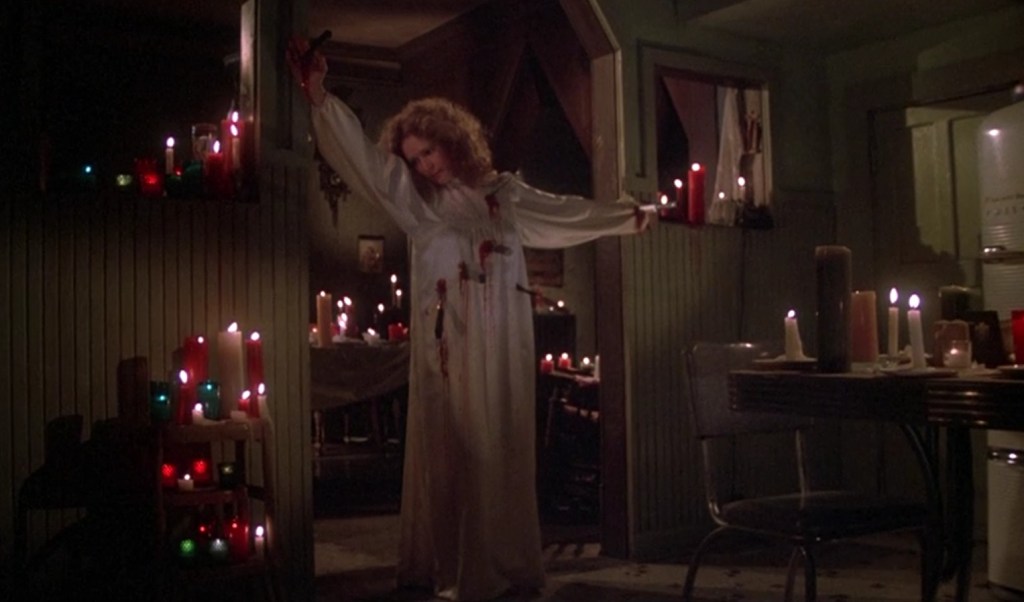
The culmination of this devotion is realized in Margaret White’s epic death scene. After literally stabbing her daughter in the back, Margaret is given a cinematic end befitting her grotesquely repressed character—being crucified with kitchen utensils (in the style of her beloved St. Sebastian statue) as Carrie burns the house down around them.
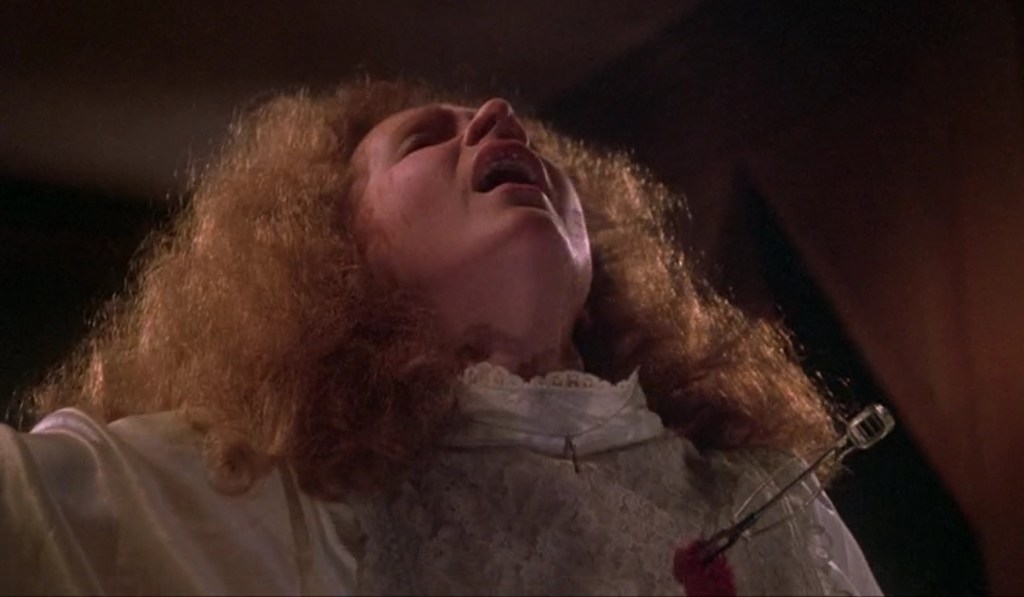
Side note: Transforming domestic cooking tools associated with nourishment and nurturing into weapons against a negligent mother feels very on point for mid-twentieth century horror.
Once the knives and forks go in, Margaret’s wild moaning starts, then her head begins to loll back and forth; opening and closing her eyes as her grunts waver between anguish and ecstasy. And they don’t stop—the euphoric groans only growing deeper and more exhaustive with each breath as Carrie quivers in the corner.
From the penetration of the first flying knife to the moment Margaret’s head finally rolls down onto her shoulder, her orgasmic death rattle lasts not five seconds, not 10, not even 30 seconds, but a nearly incomprehensible 58 seconds. That’s basically a full minute of orgasmic wails and swelling music and Margaret White tossing her head back and forth in sublime ecstasy.
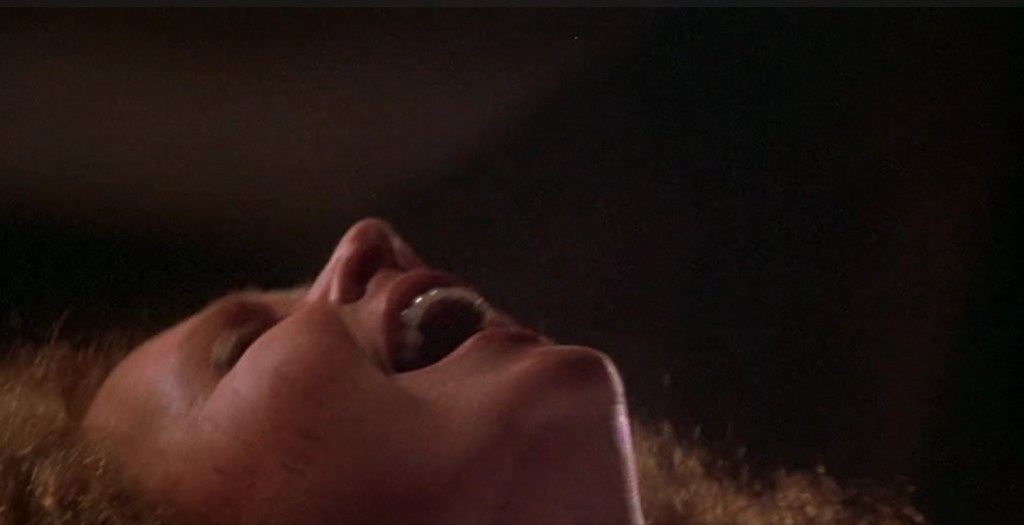
She doesn’t seem scared or confused or even in significant pain during her crucifixion, to the point where some of the moans almost sound like laughter. And while a minute may not seem like an eternity outside of the movies, in a 98-minute film, Margaret White’s death orgasm is nearly 1% of Carrie’s total runtime.
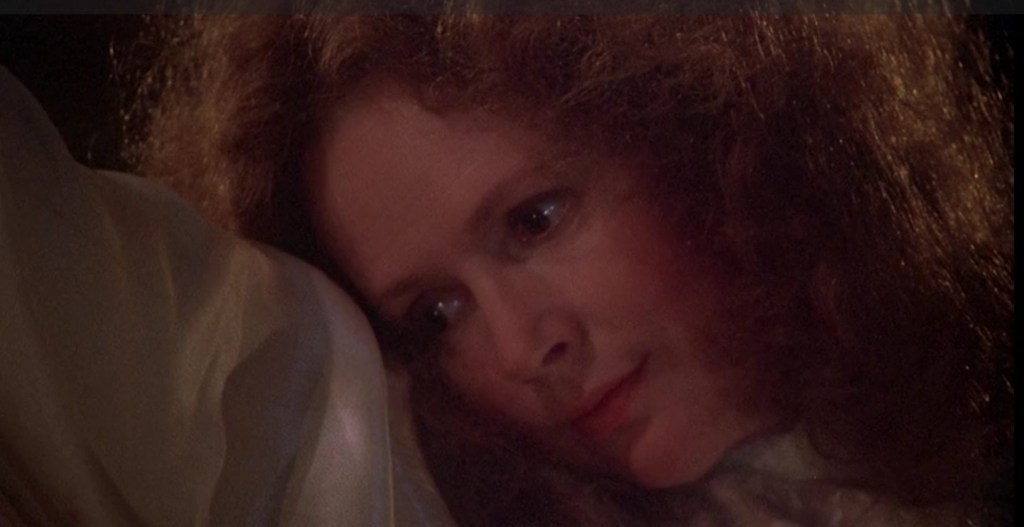
At the end of Carrie, Margaret White is absolutely ready to die, but not before letting out the window shattering, eye-crossing, time-warping orgasm she’s been holding in her entire adult life. This is what happens after decades of pent up, shamed-fueled celibacy. Being crucified by her telekinetic daughter may not have been the way Margaret White envisioned meeting her end, but in Piper Laurie’s hands, she’s more than happy to go out with a smile on her face after the best orgasm of her life. So, who really gets the last laugh?
 Allison Goldstein